motor overload protection
see NEC standards guide
N.B. - the fuse/circuit breaker are there for short circuit protection, not to protect equipment or people.
prereq information
definitions
FLC
Full-Load Current
service factor
The service factor rating is the amount of output the motor can develop without causing harm to the motor, expressed as a ratio of the rated power.
- e.g. If a 5 HP motor has a service factor of 1.15 the motor can produce an output of 5.75 HP without harming the motor.
- The service factor could be seen as a safety measure which would allow the motor to produce extra power if it was needed.
temperature rise
The temperature rise is the difference of the motor winding temperature when running at its full potential and the ambient temperature.
- e.g. If the temperature rise does not exceed 40 C when running at its full potential, the motor will not be harmed.
- This is also a safety margin.
overload
- Overloads protect the motor.
- This is why the #service factor and the #temperature rise are important.
- Look at 430-32:
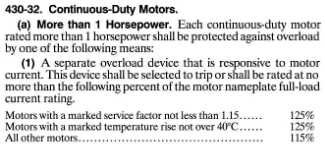
- If the #service factor is not less than 1.15 or the temperature is not more than
then you are allowed to size the overload at 125% of the FLC. - If the motor has less than a 1.15 #service factor or the #temperature rise is greater than
then it falls into the "all other motors" category and you must size the overload at 115%.
- If the #service factor is not less than 1.15 or the temperature is not more than
calculations
-
Find the motor's FLC
- if not known refer to these charts
-
determine Branch circuit conductor current load
- must be rated to 125% of FLC
- refer to table 310-16 for temperature ratings
-
Calculate Branch circuit protection requirements
- table 430-152 determines the maximum allowable current rating of the fuse or circuit breaker protecting the circuit.
- This also depends on the type of motor
- Riveer rules of thumb
- expect to use only inverse time breakers for loads
A - or dual element (time-delay) fuses for loads
A
- expect to use only inverse time breakers for loads
- table 430-152 determines the maximum allowable current rating of the fuse or circuit breaker protecting the circuit.
-
Determine the size of the #overload heaters:
!!!!! Always use the nameplate FLC if given when calculating OVERLOADS !!!!!- the standard overload values are determined by NEC Section 430-32
if the #service factorthen use 125% of FLA
OR if the #temperature risethen use 125% FLA
else use 115% of FLA - maximum overload values are found in NEC Section 430-34a:
if the #service factorthen use an overload rated of FLA
OR if the #temperature risethen use of FLA
else use an overload rated toof FLA
- the standard overload values are determined by NEC Section 430-32
-
If you have more than one motor, (or additional loads) on the feeder conductor, then the load calculation is
of the largest motor of all additional loads - When you have more than one motor or you have one motor and an additional load the feeder conductors shall be equal to the sum of the FLC for all the motors and all additional loads plus 25% of the FLC of the largest motor.
- IMPORTANT: If you have an additional load which is not a motor, and the FLC of the additional load is greater than the largest motor, you do not add 25% to the additional load, you must add the 25% to the largest motor, regardless of the size of the additional load.
- see an example of how to do this.
- When you have more than one motor or you have one motor and an additional load the feeder conductors shall be equal to the sum of the FLC for all the motors and all additional loads plus 25% of the FLC of the largest motor.
-
feeder protection
- you can size these down to the next standard size