three phase power
The following information is essential only if you want to understand how and why it works.
Ohm's Law
Where
and
said another way, Resistance is the voltage loss per Amp
3 phase power
Sometimes abbreviated as
Three-phase power uses between 3 and 5 wires to transmit alternating current. Each phase is a sinewave of voltage which is offset by
In a
This means that a 3 phase system does not require a neutral wire to return current - as in a single-phase AC system - provided that all 3 phases have a balanced load.
All else being equal, a 3 phase system (without a neutral wire) supplies the same power as a single-phase AC system (with a line and a neutral wire) using 25% less wire, by mass.
3 phase power simplifies the wiring of electric motors. If all 3 lines are wired to a motor in sequence, the resulting rotating magnetic field will cause the motor to start and run at the line frequency without any additional circuity (as is typically required for a single-phase AC motor or a DC motor).
3 phase voltages
Each phase is carried on an individual wire - a line conductor - and the voltage measured between any two lines is called the line-to-line voltage or just line voltage.
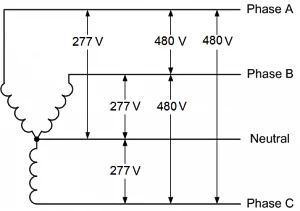
In a setup that includes a neutral wire, the electric potential measured between a line and the neutral is the line-to-neutral voltage or the phase voltage.
As depicted here, the line voltage is equal to the phase voltage multiplied by
- In a typical US 480 VAC
system this equates to a line to line voltage of 480 VAC and a line to neutral voltage of 277 VAC. - Likewise, using a Wye configuration with phase voltage of 120 VAC results in a line voltage of 208 VAC. This means that a single 3 phase transformer can provide 3 sources of 120 VAC / 208 VAC from 4 wires.
3 phase wiring
Wiring for a 3 phase system requires a minimum of 1 wire per phase. A ground conductor (indicated by either bare copper or green insulation) can be added to any 3 phase system. In normal operation, the ground carries no current.
3 phase systems are wired in either a delta or a wye configuration. Because of conservation of energy, both systems will transfer the same power at different voltages and currents. With respect to line voltage
| Wye | ||
|---|---|---|
| voltage | ||
| current |
Aside from current draw, they have other advantages and disadvantages, such as the potential for multiple output voltages or fault tolerance.
3 wire delta
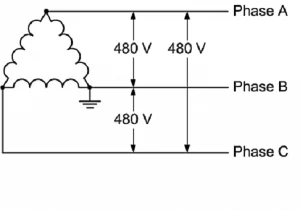
A transformer wired in this manner (called a Delta or
In this configuration, current from one phase is returned by the other two phases. All else being equal, the 3 wires required to connect a
Another advantage is the fault tolerance of a
- However, a
is only suited for balanced 3 phase loads - where all each phase will have a symmetrical current draw - such as a 3 phase motor. - The line current for a
configuration is greater than that of an equivalent Wye. Line voltage and phase voltage are the same, but the currents differ:
4 wire wye
By changing the wiring from the transformer windings (as shown), a neutral wire can be provided to allow for split phases, or to balance an asymmetrical load: if one of the loads is turned off or of a vastly different magnitude than the others, the return current is routed through the neutral with no change in the current draw on the other two phases.
A transformer configured in a Wye or Y configuration can provide both line-to-line and line-to-neutral voltages: a 208 VAC
The line voltage is equal to the phase voltage multiplied by